

REPO4EU
Engineering the digital backbone of precision drug repurposing
REPO4EU brings international scientific expertise together to advance mechanism-based drug repurposing — identifying new therapeutic uses for existing medicines. Egnosis leads the architecture and technical development of its one-stop-shop platform, connecting research knowledge, specialist tools, AI-powered guidance and expert collaboration in a system built to evolve.
~200
scientific experts involved
28+
consortium partners
15+
integrated research tools so far
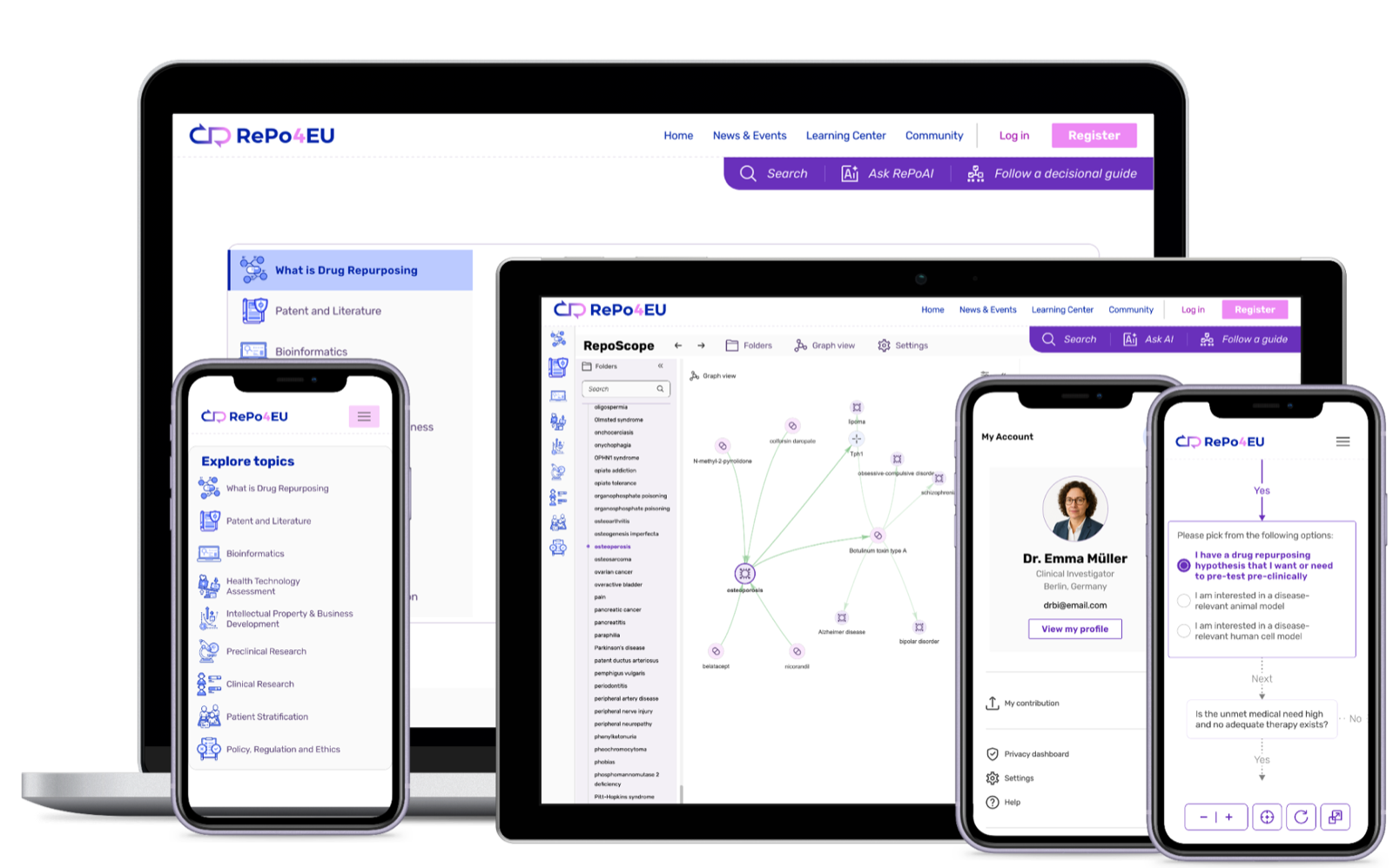
01 / The challenge
Fragmented expertise, one research journey
Coordinated by Maastricht University, REPO4EU aims to make drug repurposing more systematic by connecting research into disease mechanisms with expertise in bioinformatics, preclinical and clinical research, health technology assessment, intellectual property and regulation. That expertise is fragmented across disciplines and systems. Turning it into usable guidance throughout the research journey requires more than a conventional information portal.
The challenge for Egnosis was threefold.
-
01
Mastering multiple scientific domains
Understand highly specialised research domains well enough to translate expert knowledge, outputs and workflows into actionable technical requirements.
-
02
Coordinating complexity at scale
Gather and reconcile contributions from a network of approximately 200 experts, managing dependencies and timely input across disciplines and partners.
-
03
Engineering one integrated platform
Connect different data types, external tools and user workflows through a secure, interoperable architecture designed to accommodate new scientific capabilities.
02 / The solution
What we built
Egnosis leads the design and development of the REPO4EU one-stop-shop platform: a unified digital workspace connecting scientific knowledge, specialist research tools, AI-powered guidance and expert collaboration across the drug-repurposing journey.
-
200+
Scientific articles
-
15+
Integrated research tools
-
12+
Curated scientific databases
-
14
Decision guides
-
AI
Domain-specific assistant
-
Network
Expert matchmaking
03 / Outcomes
From alpha to public beta
From an initial alpha to a publicly released beta, the platform has moved from scientific requirements to a working digital research environment.
-
2023
Start
-
2025
Alpha release
Core knowledge hub, early AI integration and research tools
-
Sep 2026
Public beta
Platform launched publicly at RExPO26 in Berlin
-
2027
Final release
Production-ready version planned
-
2029
Infrastructure
The public beta brings scientific resources, specialist tools and collaboration into one shared platform designed for an international open-science community. Researchers can explore the environment, test its capabilities and inform the next development cycle.
04 / Impact
From technical capability to scientific value
-
01
Engineering impact
Egnosis turns consortium outputs into an operational entry point for scientific content, data services and specialised tools, replacing disconnected resources with a coherent platform.
-
02
Scientific & industry impact
AI guidance, decision guides and matchmaking can help researchers and pharmaceutical partners work across disciplines, connect with relevant experts and potentially shorten research cycles.
-
03
Human impact
More effective repurposing could unlock new therapeutic uses for existing medicines, expanding treatment possibilities for patients worldwide.
05 / The engineering process
Turning scientific complexity into engineering reality
REPO4EU began with an ambitious scientific vision, not a ready-made software specification. Defining what to build was part of the engineering challenge.
Egnosis had to understand distinct scientific domains, reconcile their requirements and translate emerging research outputs into buildable platform capabilities, continuously validating decisions with domain experts as the project evolved.
-
01
From research outputs to requirements
Starting with consortium work packages, we examined research deliverables — publications, datasets, methods and workflows — and defined the user roles, data structures and features needed to make them usable.
-
02
Validating across scientific domains
We shaped early digital concepts with domain specialists and proposed an expert board for cross-disciplinary alignment. Repeated validation refined requirements, interface flows and development priorities.
-
03
Designing for evolving requirements
With scientific components and third-party dependencies still emerging, we chose modular services and API-based integration. New tools and research outputs could be incorporated without rebuilding the platform's foundations.
-
04
Connecting an emerging AI ecosystem
As RePoAI and new integration needs emerged, we added AI-assisted capabilities and MCP connectivity. Compatible external AI services can connect to REPO4EU, while selected platform capabilities can be made available to other systems.
06 / Technology & architecture
Architecture backbone
REPO4EU required an architecture capable of bringing together scientific capabilities from multiple disciplines, many of which were still being defined as the project evolved. Egnosis designed a modular microservices backbone, with API gateways connecting scientific content, databases, specialised research tools and external systems.
Role-based access, search services and AI orchestration support different scientific workflows within one digital environment. MCP integration allows external AI systems to interact with the platform and access its capabilities, while the modular architecture provides the flexibility to incorporate new research outputs, technologies and tools as they emerge.
REPO4EU platform architecture: gateway, services and integrated research resources. Click to open the full diagram, then hover or click a box to trace its connections.
From the interface to the infrastructure
Four layers carry the platform: the experience researchers use, the application and content behind it, search and the AI assistant, and the foundation where data lives and the platform is built and run.
Core engineering capabilities
- Platform architecture & systems design
- Complex systems integration
- AI integration & orchestration
- Data services & knowledge discovery
- Identity & access management
- DevOps, CI/CD & quality control
Technology stack by layer: frontend, backend, search & AI, data and CI/CD
07 / Client perspective
In the consortium's words
Egnosis is continuously providing professional IT solutions in our EU research projects. The reaction time is fast, the finalized job is accurate. The communication with the Egnosis team is highly professional, a fast delivering team on complex web-based programming needs. We worked nicely in the Horizon 2020 project REPO-TRIAL and will now expand this in the European platform project REPO4EU.

08 / Related resources
Selected materials documenting the platform, its engineering and its progression from concept to beta.
Publications
-
RePo4EU Live: Enabling Collaborative Drug Repurposing Through Guided Use Cases
Balázs-Attila Orbán, Béla Bihari
DOI 10.58647/REXPO.25000117.v1 -
RePo4EU Live: Enabling Collaborative Drug Repurposing Through Guided Use Cases
Balázs-Attila Orbán, Béla Bihari, Aranka Ravai Nagy (Egnosis)
DOI 10.58647/REXPO.25000137.v1 -
RePo4EU: Unleashing the Potential of Precision Drug Repurposing Through a Unified Platform
Balázs-Attila Orbán, Béla Bihari, Szilárd Fejér (Egnosis)
DOI 10.58647/REXPO.24000036.v1
Talks, posters & video
-
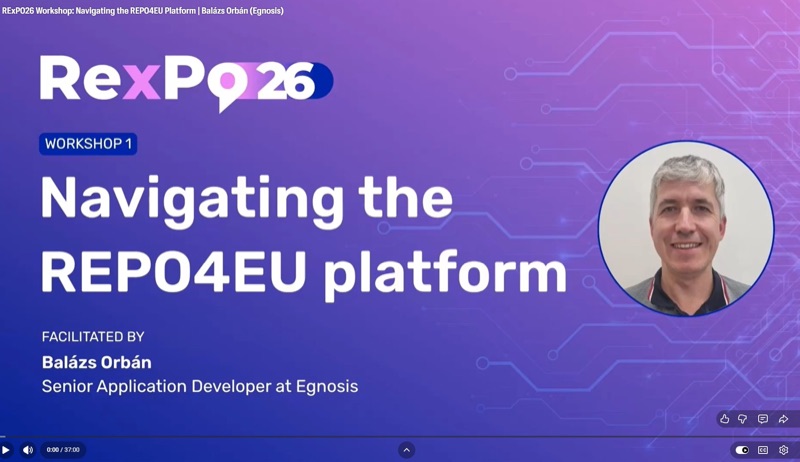 Video · RExPO26
Navigating the REPO4EU Platform — Workshop
-
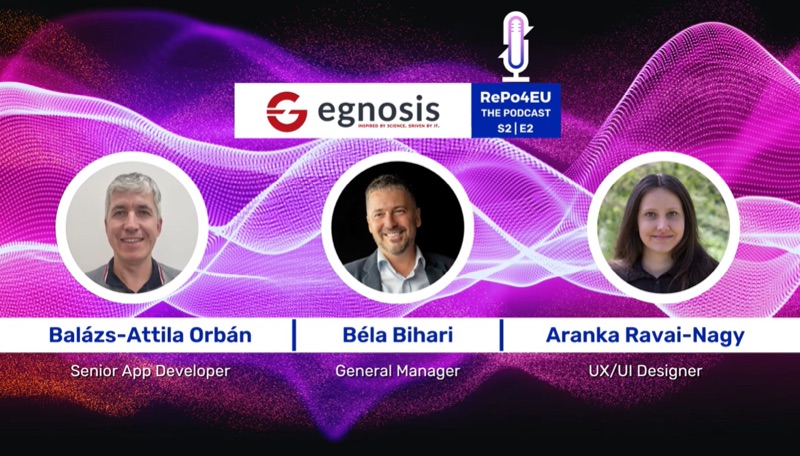 Podcast
Behind the REPO4EU Platform — Egnosis Team Podcast
-
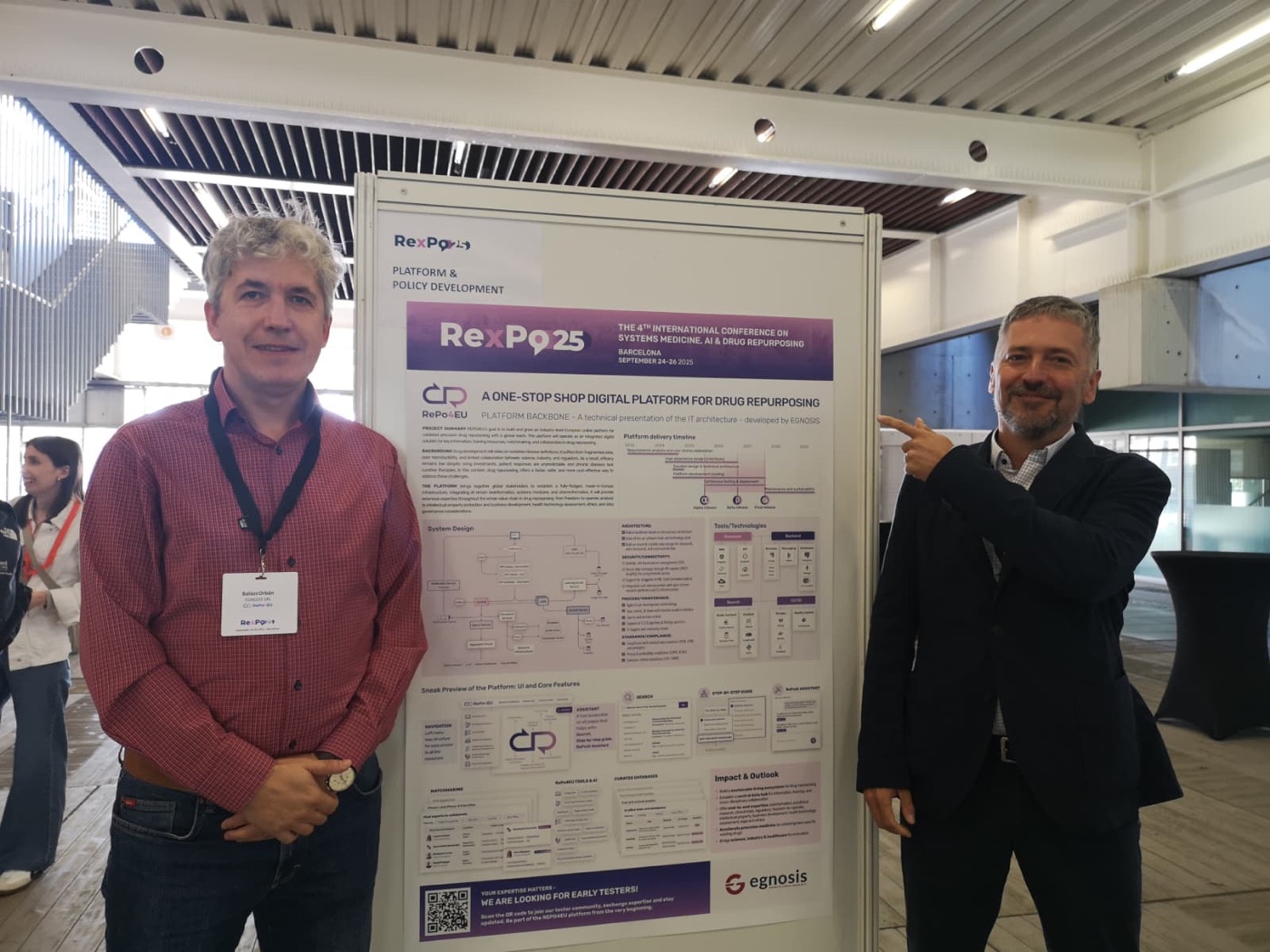
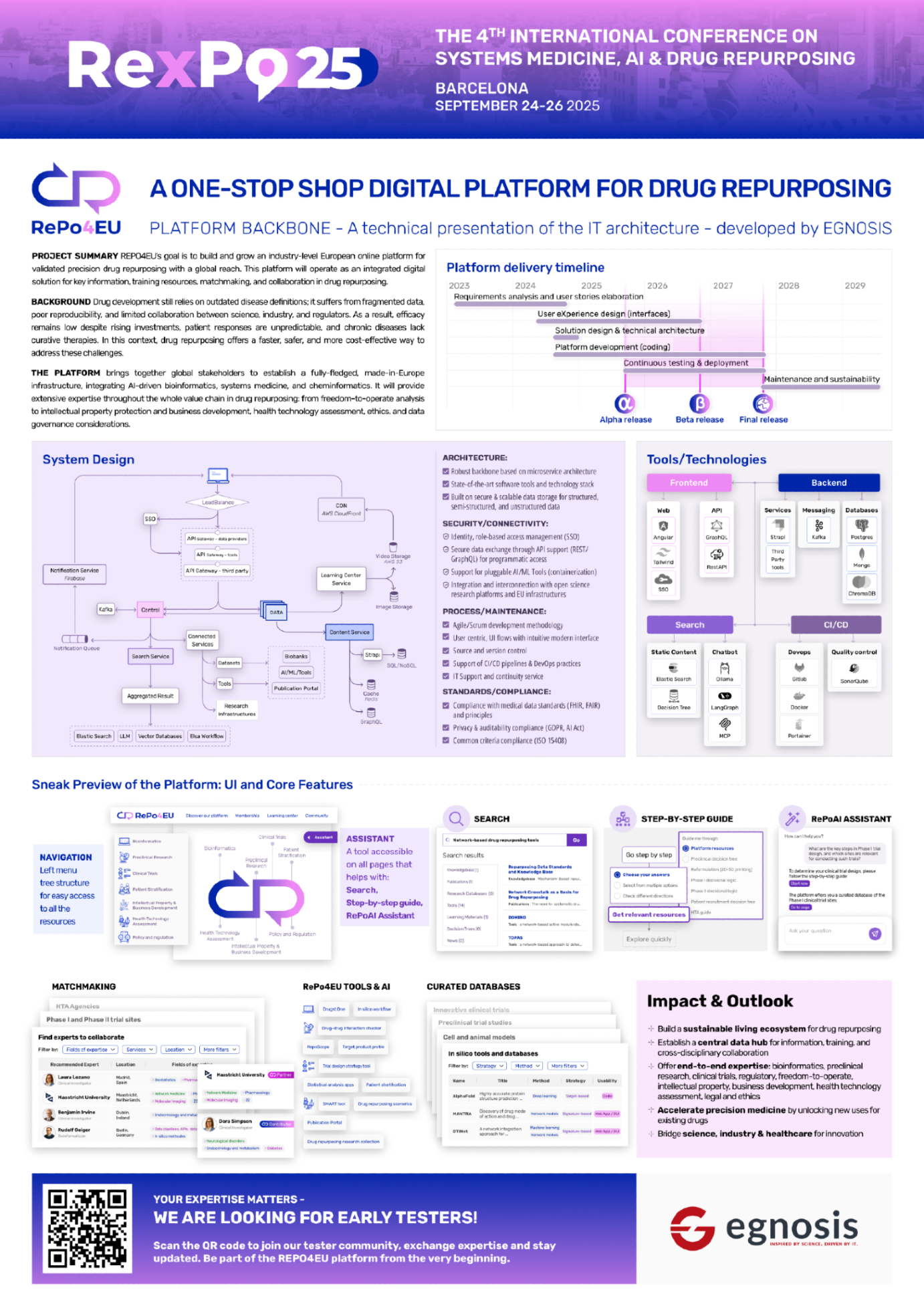 Poster · RExPO25
REPO4EU Platform Backbone — Technical Architecture Poster
-
 Video · Drug Repurposing
Drug Repurposing in Focus — REPO4EU Steering Committee Meeting
Articles
Building something that demands more than conventional engineering?
Complex requirements. Multiple systems. Evolving needs. Let's make it work.
Discuss your project with our expertExplore more of our work
See how we apply our engineering expertise to complex technology challenges.